How Do You Uploade Pictures in Markdown From Coputer
Getting Images into Markdown Documents and Blog Posts with Markdown Monster
Ane skilful justification for using a rich editor for editing Markdown or a Weblog entry is that you lot tin can provide some additional features above and beyond what a elementary text or code editor tin can provide. When you're creating content you are usually dealing with a number of things beyond plain text like lawmaking snippets, characteristic widgets and most importantly — images.
Just about any document you create is likely to include some visual content in the form of images and getting images into documents should be as quick and like shooting fish in a barrel as possible. In this post I describe all the unlike ways bachelor in Markdown Monster to add images to Markdown content.
Markdown Monster and Images
Considering images are so of import Markdown Monster offers quite a few ways to embed images into a Markdown document:
- Type it in using Markdown
or HTML syntax - Using the Embed Image Dialog to select images or Urls
- Paste images from the Clipboard
- Drag and Drop image files from the Binder Browser
- Drag and Driblet image files from Explorer into the document
- Utilize the Screen Capture Tool to Capture Screen Shots
The goal is to provide all these options because there are a lot of unlike means we often collaborate with images. Sometimes we browse for images in folders, other times we pick up images off a Web folio only copying it to the clipboard and other times we just want to option a file from deejay and embed it.
All of those options are supported along with the base characteristic of only typing an image link into the Markdown.
Embedding a Markdown Image Link
Markdown is a text format so naturally y'all can type in the Markdown representation of an paradigm using  to put an paradigm reference directly into the editor.
Some typical paradigm markup may wait like this:
Here'south an image of a drag racer in activity:
Move along.
If the image exists in a local and linkable folder the  and you know the URL or file yous're linking to this chip of simple syntax is often the quickest way to get an image into the page.
Markdown also supports raw HTML syntax, so if you demand to adorn your image with boosted tags or styles y'all can do that every bit well:
The post-obit HTML is likewise legal Markdown:
          <img src="markdownmonstericon.png"
            alt="Markdown Monster icon"
            style="bladder: left; margin-correct: 10px;" />
Note that how well this works and the syntax used may depend on where this markdown or HTML will end up getting rendered. For example, GitHub doesn't allow mode information and instead allows a few attributes like height, width, align to provide some of these feature with special syntax.
If yous use the HTML output created by Markdown Monster even so the raw HTML passes through and yous'll see the styled content as shown in a higher place.
Using the Embed Image Dialog
The most visible style to embed images into your Markdown is to utilize the Toolbar Paradigm icon (or Alt-I) to bring up the Embed Prototype dialog.
Typing raw Markdown paradigm links — using the  Markdown syntax - works of course, but in virtually cases I either don't remember the file proper name I'm trying to embed, or I'1000 dealing with an paradigm that isn't local to my document and needs to exist saved to the local folder first.
This is where the Embed Epitome Dialog comes in:

The dialog is smart enough to option up URLs or images from the clipboard when first loaded or if you re-activate the window when no paradigm has been selected however. The dialog also shows a preview of the image you're pasting so you get an idea at what y'all're looking at.
The dialog accepts input from 3 sources:
- Files on deejay
- Http Urls
- Clipboard Images
It also offers to salve certificate non-relative files or pasted images to a local relative binder. You can also optionally embed images direct into the Markdown/HTML document as base64 embedded image content.
Files on Disk
Y'all can easily select files from the file system and embed them in your page past using the file open button (…) and selecting a file from the file selection dialog.
If the file yous're selecting is not in a relative folder to the currently open certificate or more than than 1 level beneath the current document yous go the option to relieve the file in a new location relative to the certificate. Markdown Monster and so creates a link to the new file as a relative link.
HTTP URLs
You tin too type a Web Url to an prototype directly in the beginning textbox of the dialog to embed that prototype. As with local files, the image is previewed.
If an image URL — a Url that ends in an epitome extension — is on the clipboard that URL is automatically filled into the textbox. Likewise if the field is empty and you navigate abroad from the course to say a Web Browser to copy a URL, the URL is automatically filled in when the class is reactivated saving a few keystrokes.
Images from the Clipboard
You can too paste images from the clipboard into this dialog with Ctrl-5. As with the Web URL if you open the dialog and an image is on the clipboard, the image is pre-selected in the previewer and if you lot navigate away and re-activate the window with an image on the clipboard the image is automatically picked upwards and displayed.
Pasted images have to exist saved to disk showtime and so the dialog looks slightly different with a Salve to Disk button selection:
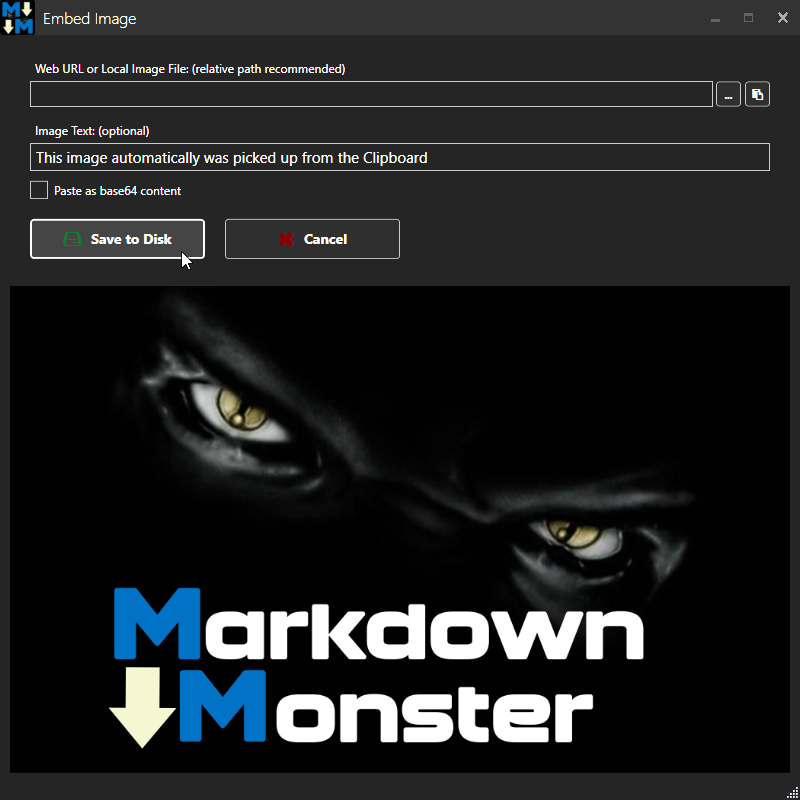
When you click it the paradigm is saved to deejay first. Then once the file exists the image'southward new file is shown in the the file Textbox.
When y'all click OK the file is embedded into the folio.
Embed Images as base64 embedded Prototype Content
Finally y'all can likewise optionally embed the epitome as base64 content straight into the Markdown document. This can be useful in some situations where you want to take a self contained HTML certificate that doesn't have external dependencies.
Markdown Monster creates a reference image link in the folio which looks similar this:
          Here's an image:![][image_ref_a32ff4ads]            More text here...
...            [image_ref_a32ff4ads]: data:image/png;base64,iVBORw0KGgoAAAANSUhEke02C1MyA29UWKgPA...RS12D==
The image itself is marked with a reference ID which is and then embedded at the bottom of the document with the bodily base64 encoded epitome information.
While this can be useful be aware that this paradigm data is going to be very big and very ugly. It's added at the very bottom of the document so it mostly stays out of the style, but it makes the Markdown document — and the resulting HTML page huge. Use this feature just if you don't have no other mode to link image content, otherwise it's almost ever better to embed links to external image files or URLs.
This is feature that's been requested past a few people over time and information technology was piece of cake plenty to add, but I still would recommend thinking carefully of whether you desire to use this. So much so that y'all have to click this checkbox — the base64 checkbox is non a tab stop so that it doesn't easily get set by accident.
Pasting Clipboard Images into the Markdown Document
Ane very productive feature when dealing with images is to re-create and paste images. If yous pick upwards images off the Web it'southward oft easiest to copy the epitome from the Web browser (using Copy Image on the browser context carte) and so simply pasting the paradigm into the document. Likewise a lot of people love to use Alt-PrtScn to capture an agile window and just paste that, although I'd fence the congenital-in screen capture tools do a improve task for near scenarios similar capturing mouse pointers allowing delayed captures and more than control over what you're capturing.
Pasting images from the clipboard direct into a Markdown certificate was ane of the almost frequent requests I've received for Markdown Monster. I was somewhat non-committal on this characteristic as I didn't employ image pasting all that frequently. I use the screen capture tools a lot or save images to deejay and then embed them with the Paradigm dialog.
Flake incidentally right around the same time I started looking into this I started using Better TweetDeck which adds the ability to paste images directly into tweets rather than embedding by file and that really set me off on realizing how useful information technology is to exist able to merely paste images from the clipboard. With support for image pasting in Tweetdeck and Markdown Monster I detect I'm using it all the time now and really miss it when it'due south not available in other places.
Long story short I underappreciated how productive prototype pasting can be compared to manually capturing, saving images in the proper location and so importing an image. Copying, pasting and saving is simple a lot faster.
Markdown Monster makes this process very easy — simply re-create an image to the clipboard then paste. MM will prompt to salvage the file for you (or you tin embed information technology into the document as base64 likewise) and then embed the resulting — hopefully relative — link to the epitome file.
I dear it because this feature actually changed the way I piece of work in other places outside of MM as I think almost pasting images a lot more these days and a lot of places — Twitter, Facebook, Github — all support this functionality in some chapters.
Dragging Images into the Markdown Document
Yous can also drag images into the Markdown Editor from Windows Explorer. Just find the file in Explorer and then drag it to the location where you want to see information technology in the Markdown certificate:

If y'all're dragging the file from a non-relative location or location down farther than one level (..\) below the document y'all're editing, MM prompts to salvage the file in a local path relative to the document - by default in the document'due south folder.
Screen Captures
If yous demand to get screen captures into a folio you can of course use Alt-PrtScn to the clipboard and so paste the image as shown in a higher place. That works fine, and for many cases that may be perfectly fine.
However, if you demand more than control over capturing or you need to capture the mouse arrow, some sort of UI interaction (like a highlighted carte du jour option or option) that's not really possible with Alt-PrtScn. For that scenario y'all can use the built-in screen capture feature of Markdown Monster.

Markdown Monster supports the basic built-in capture tool yous see in a higher place, or — if you lot own SnagIt from Techsmith — you can apply the built-in SnagIt integration to capture image using SnagIts superior image capture and editing tools. Either way both ways are directly integrated with MM and make it very quick to get captured images directly embedded into your document.
PNG File Optimization
When you lot save a PNG images from the clipboard or a file, MM will try to optimize and compress that image losslessly in the background.
Afterwards a PNG file is saved it runs a lossless image optimizer confronting the PNG image to reduce the size of the file. Typical image size reductions for images saved from clipboard are 20–30% typically, for others it depends how optimized the images are in the starting time place. I find for images from Pigment.NET I typically come across a ten–15% smaller prototype, x–xx% or more from SnagIt images. Only your mileage will vary.
Compression ratios may vary but it's overnice to not have to worry too much about the level of PNG compression of your epitome tool (or the producer of the PNG) and allow the optimizer do the work for you in the background.
The PNG Optimizer works in the Background
Please be aware that the PNG optimizer runs in the background asynchronously, so images are not immediately available. Depending on size and machine speed optimization can take from a few seconds to a few minutes. If you publish your image (to Git or your Web log for instance) earlier optimization is complete y'all may end upwardly with the non-optimized paradigm. Images are replaced in identify, but only after optimization is complete.
Comparing Epitome Size for jpg and png: Manual simply a skillful Idea!
In the future it might be nice to also compare sizes of images created as PNG and JPG and pick the smaller of the ii. For a number of things PNGs are preferrable both in size and quality (since they're lossless), only non quite sure how to best provide UI for this since the optimization operations are quite boring and would hold up the workflow. Currently I ofttimes save images both every bit PNG and JPG and pick the i that'due south smaller for my document. If you think this is nit-picking — the size differences between formats can often exist quite drastic and for big files similar Weblog mail service banner files that are often quite large it can mean the diffence between an 80k image or 500k image. For big images in detail it pays to compare prototype sizes!
My manual workflow for this is:
- Paste or embed an paradigm with the Prototype dialog
- Relieve equally Png
- Save every bit Jpg
- Right click on the doc tab, Open Folder
- Compare the file size of both png and jpg files
- Delete the larger one
- Change the image file extension in the document if necessary
Manual — aye. Worth it for large images: Definitely if you can salvage 100k or often much more for every image load on your connexion!
What'due south next? Storage Mechanisms
There's yet more than that tin exist done in this space — 1 affair that has already come up and has been addressed with addins today — is the ability to save images to other storage spaces like Azure Blob Storage, or Imgur or some other storage mechanism like DropBox or OneDrive.
I've looked at this a few times and backed out of implementation because the feature fix of MM is nonetheless in flux — at that place are a lot of paths that lead to saving images in MM and the mode this works differs quite considerably in places. To build a consolidated image saving mechanism will require a fair flake of abstraction and some internal UI logic (for picking save location etc.) that makes this trickier than just a unproblematic provider API.
Today if you lot desire to save and embed images using a custom store you have to create an Addin to make it happen. Ane such addin exists in the form of the Save Image to Azure Blob Storage Addin (you can load it from Tools -> Addin Manager:
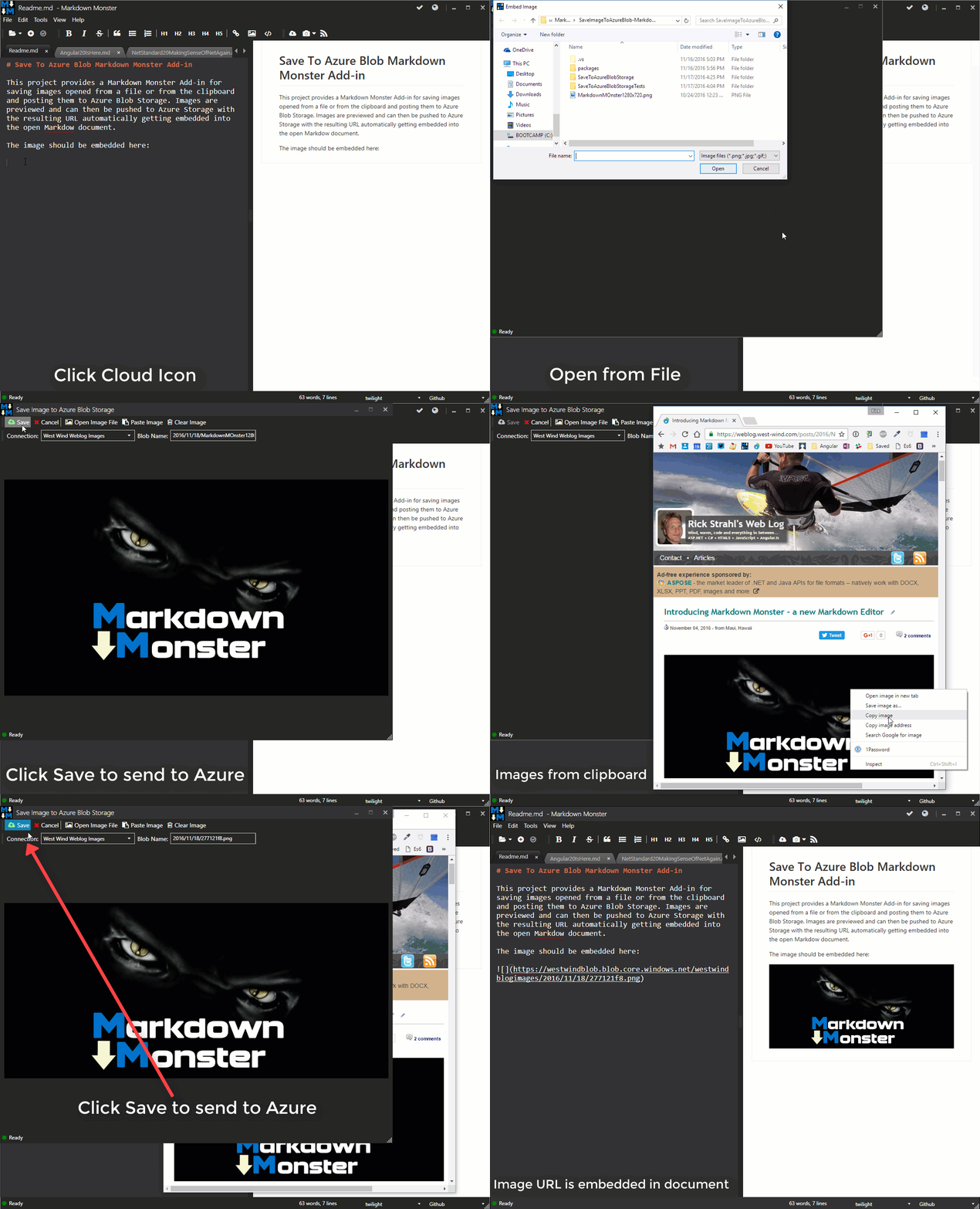
This is a full featured addin that duplicates some of the functionality in the Embed Image Dialog then this is non trivial to create. However, to create one for other storage providers or prototype services, they could probably copy and change this existing addin and claw upward the appropriate API functionality.
This will get easier in the future as nosotros figure out a better way to make providers more generic, either via a direct image saving Provider API that can be extended and plugged into, or via single addin that provides upload capabilities to various providers.
I'm hoping to hear from you fine people, to see what's important you in the way of providers, and hopefully tin can solicit some participation in creating extensions that can interface with other services. The code for both Markdown Monster and all the Addins is available on Github and open up for comments and discussions.
Summary
And here y'all thought Image embedding is an open and shut volume, right? Epitome embedding is a preferential affair for most people — everybody does it a little differently and for this reason Markdown Monster tries to provide a number of dissimilar ways that you lot can become your images into the page efficiently.
I know thinking about the paradigm workflow and calculation features similar image pasting and dragging images directly into the document have really improved my productivity while creating content and I hope the options in Markdown Monster tin can provide some of these same benefits to you.
And so if you haven't checked into the image embedding features in Markdown Monster, experiment a piddling and run into if you lot tin can't optimize your own workflow and make image embedding more efficient.
Resource
- Markdown Monster
- Salve Prototype to Azure Blob Storage Addin
westmorelandropened.blogspot.com
Source: https://medium.com/markdown-monster-blog/getting-images-into-markdown-documents-and-weblog-posts-with-markdown-monster-9ec6f353d8ec
0 Response to "How Do You Uploade Pictures in Markdown From Coputer"
Post a Comment