Upload Failed! Empty Response to Http Request.
The HTTP Request connector allows you lot to include the following types of parameters:
-
Query params
-
A map of multiple query params
-
URI params
-
A map of multiple URI params
-
Headers
-
A map of multiple headers
Additionally, you lot can also send form parameters with your request, included in the Mule message payload. Y'all can also include attachments in your request by adding an Zipper processor to your flow.
| Call up that when using Studio, if the API y'all want to achieve has a RAML file, referencing this RAML file in the global element exposes the API's metadata, and Studio proactively displays all the available properties for each performance in the API. |
Query Parameters
By clicking the Add Parameter button you can add together parameters to your request. If you lot leave the default query-param every bit the blazon of parameter, you can add together new query parameters and assign names and values to them.
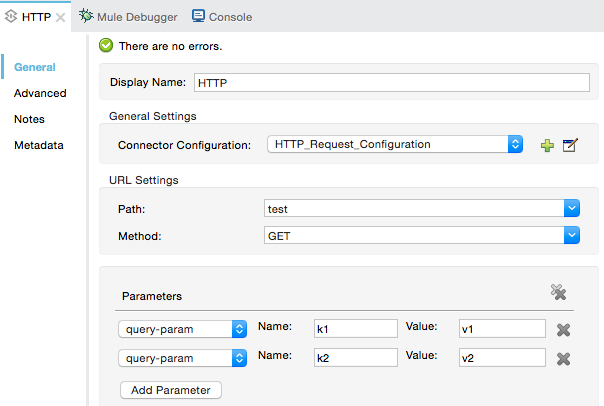
The in a higher place configuration performs a GET request to http://www.case.com/test?k1=v1&k2=v2.
| Both the proper noun and value fields let the use of MEL expressions. |
If query parameters should be set dynamically (for example, while at design fourth dimension you don't know how many query parameters are needed in the request), so yous can change the parameter type to query-params, which accepts an array, and y'all can assign it a MEL expression that returns a map of parameters:
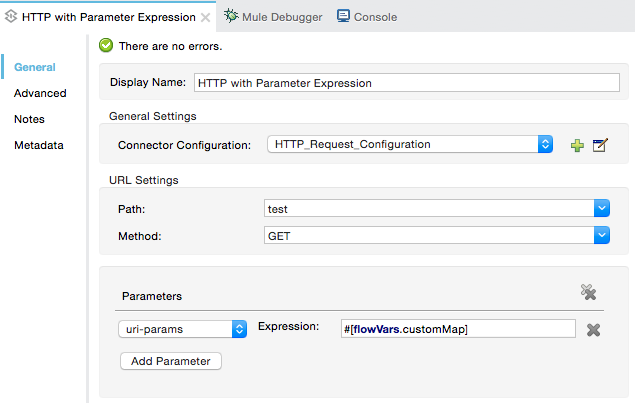
For this case, you must first generate a variable named customMap. If you assign that variable a value through the following MEL expression:
#[{'k1':'v1', 'k2':'v2'}]
Information technology generates the aforementioned asking than the previous example, a GET request to http://www.example.com/test?k1=v1&k2=v2
The query-param and query-params elements can be combined inside a single connector. The parameters resolve for each request (evaluating all the MEL expressions in the context of the current message), and in the order they are specified within the request builder. This allows to override parameters if necessary. If the same parameter is defined more than than one time, the latest value is used.
URI Parameters
When parameters should be part of the path, placeholders can exist added to the "path" attribute with a name for each of them, and so they must be referenced by a uri-parameter:
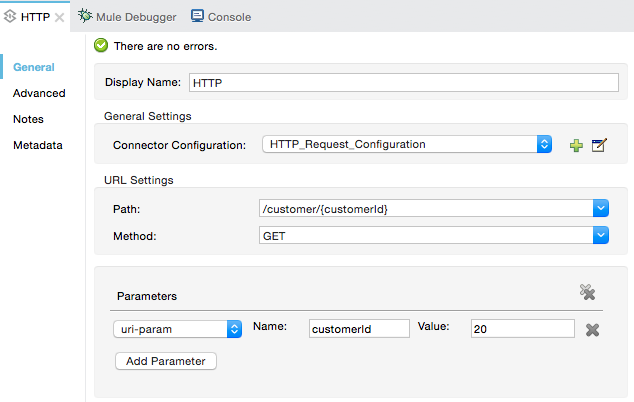
If yous offset blazon the placeholder into the "path" field, Studio automatically adds the corresponding uri-param below in the parameters department, saving yous some of the hassle.
This performs a GET request to http://world wide web.example.com/customer/twenty.
| Both the proper name and value fields allow the utilise of MEL expressions. |
Dynamically Setting URI Parameters
If URI parameters should be set dynamically they can be set through a MEL expression that returns a map of parameters to set:
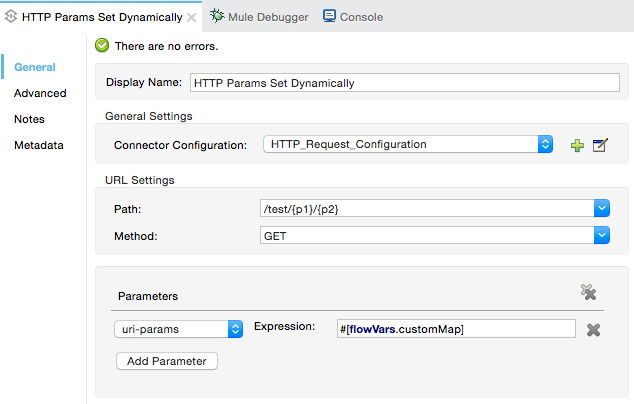
If any additional uri-param parameters are added automatically while yous type the value in the path field, delete these, as they are addressed by the dynamic uri-params field. |
For this instance yous need to create a variable named customMap. If you lot set that variable to the MEL expression #[{'p1':'v1', 'p2':'v2'}], information technology generates a GET request to http://www.example.com/test/v1/v2.
Just as with query parameters, the uri-param and uri-params elements can exist combined inside the connector. They are resolved for each request (evaluating all the MEL expressions in the context of the electric current message), and in the society they are specified inside the request builder. This allows you to override parameters, if necessary. If the same parameter is divers more than in one case, the latest value is used.
| In every instance, all the placeholders used in the path to reference URI parameters should match the names of the URI parameters inside the request builder (after all MEL expressions were evaluated). |
Yous can add HTTP headers to the asking just as easily as query parameters:
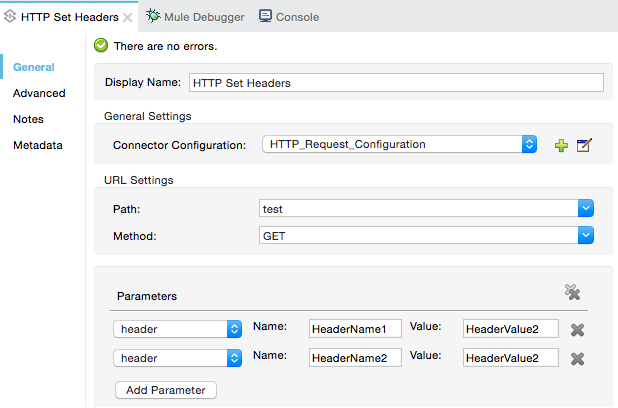
This performs a GET asking to http://www.example.com/test, calculation the following headers:
HeaderName1: HeaderValue1 HeaderName2: HeaderValue2 | Both the name and value fields let the use of MEL expressions. |
This is exactly equivalent to setting outbound backdrop in the Mule message through backdrop transformers. Outbound properties map as HTTP headers in the asking. Thus, you could achieve the same past adding two properties transformers before the HTTP Request connector, one for each of the new headers that need to be ready:
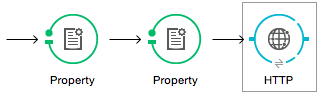
In both cases, the headers of the response map equally entering backdrop of the Mule message after the response is candy.
If headers must be ready dynamically (for example, you don't know at design time how many extra headers are needed in the request), they can exist ready through a MEL expression that returns a map of headers:
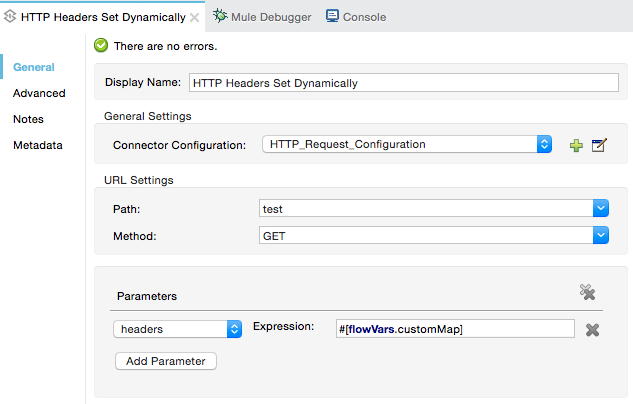
For the above case to piece of work, you lot first need to generate a variable called customMap. If y'all ready that variable to the following MEL expression:
#[{'TestHeader':'TestValue'}] It generates a GET request to http://www.example.com/examination, adding the following header:
But every bit with query parameters, the header and headers elements can be combined in the connector. They resolve for each request (evaluating all the MEL expressions in the context of the electric current message), and in the order they are specified inside the request builder. This allows to override parameters if necessary. If the same parameter is divers more than than one time, the latest value are used.
Sending Grade Parameters in a Post Request
In order to send parameters in a POST request, the payload of the Mule message should exist a map with the names and the values of the parameters to ship. Hence, i way of sending course parameters in your request is adding a Set Payload element before the HTTP Request connector to set the payload of your bulletin to the form parameters to ship:
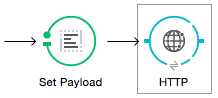
For instance, if you use the Set Payload element to set your payload:
#[{'key1':'value1', 'key2':'value2'}]
A POST request is sent to http://www.example.com/test, with Content-Type: application/ten-www-form-urlencoded, and the body is "key1=value1&key2=value2"; merely as if a browser would have sent a request after the user submitted a form with these two values.
westmorelandropened.blogspot.com
Source: https://docs.mulesoft.com/http-connector/0.3.9/http-request-connector
0 Response to "Upload Failed! Empty Response to Http Request."
Post a Comment