what metric system suffix is used to describe weight?
What is Metric System?
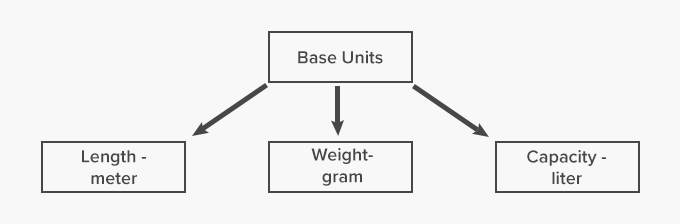
The metric system is a arrangement of measurement that uses the meter, liter, and gram as base of operations units of length (distance), capacity (volume), and weight (mass) respectively.
To measure smaller or larger quantities, we use units derived from the metric units
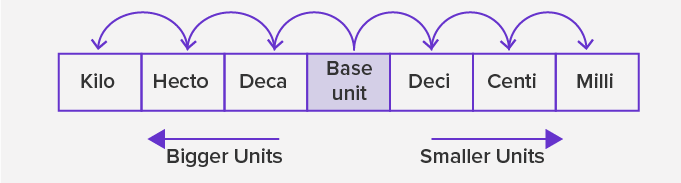
- The given figure shows the organisation of the metric units, which are smaller or bigger than the base unit.
- The units to the right of the base unit are smaller than the base of operations unit. Equally nosotros move to the correct, each unit is 10 times smaller or i-tenth of the unit to its left. So, a 'deci' means 1-tenth of the base of operations unit, 'centi' is one-tenth of 'deci' or 1-hundredth of the base of operations unit of measurement and 'milli' is ane-10th of 'centi' or 1-thousandth of the base unit.
- The units to the left of the base unit are bigger than the base unit of measurement. As we move to the left, each unit of measurement is 10 times greater than the unit to its right. And so, a 'deca' means ten times of the base of operations unit, 'hecto' is ten times of 'deca' or hundred times of the base unit of measurement and 'killo' is ten times of 'hecto' or thousand times of the base unit.
| Kilo | Hecto | Deca | Base Unit of measurement | Deci | Centi | Milli |
| g | 100 | x | 1 | 1/10 | 1/100 | 1/one thousand |
So, the units for length, weight (mass) and chapters(volume) in the metric system are:
Length: Millimeter (mm), Decimeter (dm), Centimeter (cm), Meter (thou), and Kilometer (km) are used to mensurate how long or wide or tall an object is.
Examples include measuring the thickness or length of debit card, length of cloth, or altitude betwixt two cities.
| Kilometer (km) | Hectometer (hm) | Decameter (dam) | Meter (g) | Decimeter (dm) | Centimeter (cm) | Millimeter (mm) |
| one thousand | 100 | 10 | ane | i/10 | 1/100 | i/1000 |
Weight: Gram (1000) and Kilogram(kg) are used to measure how heavy an object, using instruments.
Examples include measuring weight of fruits or, our own body weight.
| Kilogram (kg) | Hectogram (hg) | Decagram (dag) | Gram (thousand) | Decigram (dg) | Centigram (cg) | Milligram (mg) |
| 1000 | 100 | 10 | 1 | i/10 | ane/100 | i/1000 |
Capacity: Milliliter (ml) and Liter (l) are used to measure how much quantity of liquid an object can agree.
Examples include measuring the corporeality of juice in a juice can, or amount of water of in a water tank.
| Kiloliter (kl) | Hecto liter (hl) | Deca liter (dal) | L iter (fifty) | Deci liter (dl) | Centi liter (cl) | Milli liter (ml) |
| 1000 | 100 | 10 | i | ane/10 | i/100 | 1/1000 |
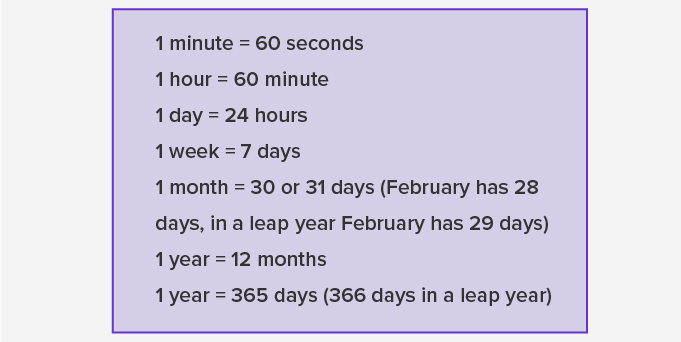
Fourth dimension:2d is the base unit for fourth dimension. The other metric units of time are:
Metric Conversions: Meters, grams and liters are considered the base of operations units of length, weight and book, respectively.
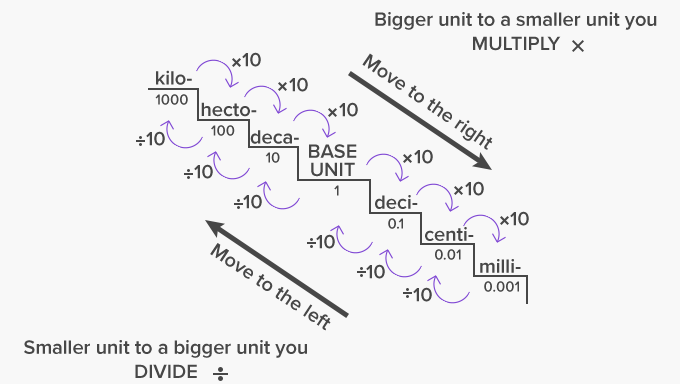
Here's how we can multiply or separate for making metric conversions. To convert a bigger unit to the smaller unit, we move left to write, we multiple by 10. Moving correct to left, from smaller unit to bigger, we divide by 10.
Permit us wait at some examples of converting from one unit to another.
Case 1: Convert 5 km to thousand.
As 1 km = 1000 m
Therefore, v km = 5 × 1000 = 5000 1000
Case 2: Catechumen 250 kg to milligrams.
We know, 1 thousand = 1000 mg and 1 kg = chiliad grand
And so, we beginning convert the kg to g as:
1 kg = 1000 1000
Therefore, 250 kg = 250 × 1000 g = 250,000 g
At present, converting m to mg:
1 yard = 1000 mg, therefore: 250,000 chiliad = 250,000 × 1000 mg = 250,000,000 mg
Example iii: Convert 250 ml to liters.
1 liter = thousand ml
Therefore, 450 ml = 450 ÷ m = 0.45 liter
The US Standard Units or the Customary Organization uses customary units.
This system measures:
- Length or distance in inches, feet, yards, and miles.
- Capacity or volume in fluid ounces, cups, pints, quarts or gallons.
- Weight or mass in ounces, pounds and tons.
Fun Facts
-
A tonne is 1,000 kilograms.
-
The metric system has its beginnings back 1670 past a mathematician called Gabriel Mouton.
-
Since the 1960s the metric system is chosen the "International System of Units" or "SI" (from the French "Système International").
-
The prefixes of the metric system tin can be remembered using the mnemonic "King Henry Died of Drinking Cold Milk"
-
There are units greater than the kilo likewise. These have prefix mega, giga and tera. A mega is g times of kilo. A giga is yard times of mega and a tera is 1000 times of a giga.
 Permit's sing!
Discover a millimeter in a pencil tip,
Find a centimeter in big paper clip.
Find a millilitre in the juice you drink,
Notice a liter in the water filled in the sink.
Find a gram in the mango you ate,
Detect a kilogram in information technology's bundle of eight!
 Allow's do it!
Instead of handing our word trouble worksheets to your child, site real life instances in which the child is required to measure out length, weight or capacity in metric units or convert bigger units into smaller units. For case, at the grocery store, ask your child to weight eight apples using a digital weight residue, in kilograms. Then ask him to convert the weight into grams and milligrams.
 Related math vocabulary
westmorelandropened.blogspot.com
Source: https://www.splashlearn.com/math-vocabulary/geometry/metric-system
0 Response to "what metric system suffix is used to describe weight?"
Post a Comment